Posts

Showing posts with the label alleged contradictions

Are You Worried or Are You Concerned?

It's very easy to confuse worry with concern especially in the midst of the current Coronavirus crisis, right? China even reports that Christians are persecuted in the midst of the crisis. A new virus in China called the Hantavirus is also emerging. However, the Bible says not to worry but it doesn't say we shouldn't be concerned. When Jesus spoke in Matthew 6:25-34 and Luke 12:22-31 about not to worry - He didn't mean that we're to be idle. On the contrary, you could consider that 2 Thessalonians 3:6-10 says that if any man works not then that man should not eat. 1 Timothy 5:8 says that you must provide for your family or be considered worse than a heretic. The Book of Proverbs also condemns laziness in 6:6-12, 10:4-5, 12:11, 12:24, 13:4, 14:23, 19:15, 20:4, 24:30-24, and 26:15. If you ask, "If you're not worried then why do you work?" The answer lies in the difference between worry and concern. How do you differentiate both sides? Although the two ...

Did the Lord Jesus Condemn the Washing of Hands as a Hygienic Practice?

The Coronavirus is indeed spreading out, right? One of the biggest and most practical safety applications is to wash your hands properly . I have no problem with that when health experts tell me to do this and that for the good of people's health. However, some might think that Jesus condemned the washing of hands as a hygienic practice. Let's try to clear out this misunderstanding by understanding what was really emphasized when Jesus rebuked the Pharisees. I decided to go to search for some commentaries. It's because I believe that Jesus would convict me to wash my hands for health reasons. A bigger picture of the context would tell us that it was more than just going against the Pharisees' lack of compassion. It was most likely going against superstition. Here's an excerpt from the " Enduring Word Bible Commentary " where we can read the following on the issue of handwashing: b. But eat bread with unwashed hands: The religious leaders meant elabo...

The Controversy About Rahab's Lie

Image
It's a controversial topic as to why Rahab was even written and commended in Hebrews 11:31 and James 2:25 as an example of faith. The controversy lies in the fact that she lied to the Canaanite authorities. I have consulted at least three late Presbyterians - Matthew Henry, Vernon McGee, and Robert C. Sproul Sr. for some possible answers. Why was Rahab written in spite of the fact that she lied to the Canaanite authorities? Matthew Henry had written this about Rahab's lie: Now, (1.) We are sure this was a good work: it is canonized by the apostle (James. 2:25 ), where she is said to be justified by works, and this is specified, that she received the messengers, and sent them out another way, and she did it by faith, such a faith as set her above the fear of man, even of the wrath of the king. She believed, upon the report she had heard of the wonders wrought for Israel, that their God was the only true God, and that therefore their declared design upon Canaan would und...

To Answer or Not to Answer a Fool?

Image
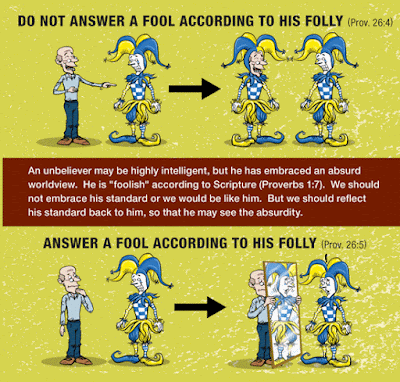
To answer or to answer not a fool is a heavy question. Proverbs 24:4-5 seems to be contradicting statements. We read at first to never answer a fool according to his folly yet the second verse says to answer a fool according to his folly or he will be wise in his own conceit. So should you answer a fool or not? The answer would be most likely a case to case basis. It's like Matthew 5:16 says to let your light so shine before men yet we also read in Matthew 6:1 not to perform acts of righteousness in public. Yet there's no contradiction. Jesus told people to let people see your good works yet the problem is not about doing it in public but the motive behind it. It's wrong to do good works in public to be applauded by men and only for their applause. So how would Proverbs 26:4-5 apply? The illustration above by Creation.com seems to show a good answer. Ever heard of the statement to never stoop down to the level of the fool? It says, "Answer not a fool otherwise yo...

Possible Meaning Behind the 40 Years in 2 Samuel 15:7

Another accusation against the Bible is the use of the term forty years to describe the time it took Absalom to finally throw his dastardly rebellion against his father David. Some of the modern versions use four years instead of forty years to explain the rebellion of Absalom. It couldn't have happened literally that Absalom waited for literal forty years - otherwise David would have already been too dead to be rebelled against or to even launch an attack. So what would be a better suggestion for the forty years in 2 Samuel 15:7? Here's a series of suggestions that could make sense about the "forty years" that took place before Absalom decided to rebel against his father: Absalom could have actually been 40 years old at that time. Considering that David was already 49 when he saw Bathsheba and 50 when he had Solomon. David was 30 when he began to reign and 70 when he died. If Solomon were growing up by that time then David would have been an old man by then.  Jo...

Ahaziah's Seemingly Contradicting Ages in 2 Kings 8:26 and 2 Chronicles 22:2

There is a big issue right now concerning the King James Bible which some critics of it say that there's the problem of a copyist error. New and modern versions of the Bible use 22 instead of 42 in 2 Chronicles 22:2 in contrast to the KJB. But why do we have 42 instead of 22 in older translations? One suggestion is that Ahaziah is not literally 42 years old but it was the amount of time from his great-grandfather via his mother Athaliah (who was his mother's paternal grandfather) Omri's reign up to his time actually totaled 42 years. Omri began his reign in 884 B.C. and Ahaziah began his reign on 842 B.C . Now it's time to do the math, shall we? 884 B.C. less 842 B.C. equals 42 years ! In other words, 2 Chronicles 22:2 talks about the amount of time that Omri reigned up to the time when Ahaziah of Judah became king! Also, here's one thing to consider about the age of marriage. The marriage standards back then were very different from today. It's possible tha...

Why Were Achan's Family Members Also Put to Death For Their Father's Sin?

Image
As I was reading through Joshua today - I remembered that one of many objections against the Bible also includes the "unjust" stoning of Achan and his family. I couldn't forget how some atheists have used this passage to say that "God is unjust" - never mind that many of them believe in Richard Dawkins' famous statement that there's no good and no evil but only pitiless indifference. So how can we handle it? First, let's take a look at this verse given in the Book of Deuteronomy: Deuteronomy 24:16  The fathers shall not be put to death for the children, neither shall the children be put to death for the fathers: every man shall be put to death for his own sin . Also, if you do a review of the miserable end of Korah, we would later realize that the children of Korah didn't perish or get swallowed into Hell alive with their father: Numbers 26:10-11  And the earth opened her mouth, and swallowed them up together with Korah, when that c...

Did David Dance Before the LORD God Only In His Underwear?

What can be used as a poor excuse of indecency is to misquote 2 Samuel 6:14 was that David danced before the L ORD God in a linen ephod without understanding the full context.  Some have even erroneously drew into the conclusion David like he was just in his underwear.  Seeing various worldly films about David, most of the time, he is pictured to have gone so immodest as to dance only in his underwear. It's time to take a look at what some commentators have to say on the matter: Matthew Henry 6:12-19 It became evident, that happy was the man who had the ark near him. Christ is indeed a Stone of stumbling, and a Rock of offence, to those that are disobedient; but to those that believe, he is a Corner-stone, elect, precious, 1Pe 2:6-8. Let us be religious. Is the ark a blessing to others' houses? We may have it, and the blessing of it, without fetching it away from our neighbours.  David, at first setting out, offered sacrifices to God.  We are likely to speed in...

Why Did God Blame Adam and Not Eve for Bringing Sin to Mankind?

Image
In Genesis 3, we read the account of Adam and Eve and how they fell down and God blaming Adam for it.  At first, it does sound "unfair" that God laid the blame on Adam.  In fact, Romans 5:12 and 1 Corinthians 21-22 point out that it was by ADAM that death and sin came into the world.  However one must analyze Genesis 3 further to why God laid the blame on Adam and not Eve.  If one checks it out, common sense in Genesis 3 will tell us that when Satan was tempting Eve, Adam was there.  Adam had the ultimate responsibility over Eve.  That is, he was really there the whole time otherwise Eve would not immediately give the forbidden fruit to Adam.  Also, one has to notice in Genesis 2:16-17 that God told ADAM beforehand and not Eve who was yet to be formed that the Tree of Knowledge was 100% forbidden.  That is, Adam knew he had the responsibility to really stop Eve.  But instead, Adam allowed himself to be deceived and being the head of the ho...

Does Forgiveness Negate Justice?

There is the old classic argument I sometimes struggle with, "If I forgive doesn't that omit justice?  Why can't I have revenge?"  The answer is no.  Here's the issue- forgiveness DOES NOT by any means negate justice.  Here's some truths we are to understand about the relationship between forgiveness and justice:  It doesn't mean that God forgives that a Christian can sin all they want.  God may have forgiven the Christian but that does not mean that He will not chastise the sinning believer.  Hebrews 12:5-6 is clear that whenever a Christian sins, they endure chastising. Although a Christian who stumbles in the faith won't lose their salvation because they CANNOT completely fall away, God is still faithful and just to chastise the believer until they confess their unconfessed sins. The illustration of forgiveness and justice is plain simple- punishment is given but it does not mean that the person is being personal.  The teacher...

Money or the Love of Money is the Root of All Evil?

There is such a misunderstanding when people cross the extreme into saying that money per se is the root of all evil. However, that is NOT true. Remember God ordained the monetary system for Israel. Money in itself is not to be regarded as evil. People need money to survive and money is a major concern as a necessity. Money is needed as long as the fallen world still runs and God will say so when all the money of the world will become useless. What is wrong is when people love money over God and this is the wrong kind of love. 1 Timothy 6:10 is clear that not money itself is evil but it's rather the LOVE for it. That is where people would do anything to get money- cheat, steal, commit adultery, swindle a close friend so one doesn't need to pay, become part of the occult, do bad jobs (like abortion, robbing banks, swindling and pornography) which they think grants "instant money". They could care less about the consequences as long as it gives them a profit. They...

Explaining What Jesus Emphasized in Eye for Eye and Tooth for Tooth

Exodus 21:24-25 says, "Eye for eye, tooth for tooth, hand for hand, foot for foot, burning for burning, wound for wound, stripe for stripe." Jesus said in Matthew 5:38-39, "Ye have heard that it hath been said, An eye for an eye, and a tooth for a tooth: But I say unto you, That ye resist not evil: but whosoever shall smite thee on thy right cheek, turn to him the other also." Did Jesus negate the value of justice? Not at all. Here one has to realize the reality of the fact that Jesus as said did not come to destroy the Law but to FULFILL it (Matthew 5:17) in that very same chapter. Overall, Jesus DID NOT negate justice but rather He went against the wrong use of the Law which the Pharisees according to history, used it to justify their vengeful behavior and UNJUST scales. So it's highly possible that these Pharisees were already giving people punishment not according to God's weights but their own weights. One has to realize that first and foremo...

Who Were the Sons of God in Genesis 6:1-4?

This is a controversial issue among Bible scholars even among the truly born again Christians to who the sons of God were in Genesis 6:1-4. One has to closely examine the grammatical and textual usage before jumping into any conclusions: And it came to pass, when men began to multiply on the face of the earth, and daughters were born unto them, That the sons of God saw the daughters of men that they were fair; and they took them wives of all which they chose. And the LORD said, My Spirit shall not always strive with man, for that he also is flesh: yet his days shall be an hundred and twenty years. There were giants in the earth in those days; and also after that, when the sons of God came in unto the daughters of men, and they bare children to them, the same became mighty men which were of old, men of renown. One has to notice the context. Kindly notice that the text DOES NOT SAY that the giants were the children of the sons of God and daughters of men. Yes giants do exi...

Commentary on Ecclesiastes 7:15

Ecclesiastes 7:15 - "All things have I seen in the days of my vanity there is a just man that perisheth in his righteousness and there is a wicked man that prolongeth his life in his wickedness." This verse is seemingly contradictory to Proverbs 10:27 saying, "The fear of the LORD prolongeth days but the years of the wicked shall be shortened." It's indeed quite true that many people in this world die early but sadly many of them are also good Christian workers aside from the heathen people. On the other hand, there are many bad people who can really live long which develops the statement that bad grass doesn't die easily. It's a shame that some Christians die of fatal illnesses or accidents while it took a long time to get rid of the world's greatest terrorists. There's indeed a huge gap between a good Christian who dies at 35 years old or even less (such as the case that a good Church worker died at only 22 years of age ) to an antago...

Did Christ Abolish the Law or Fulfill It?

Ephesians 2:15- Having abolished in His flesh the enmity, even the law of commandments contained in ordinances; for to make in Himself of twain one new man, so making peace; So here's a confusion that people would try to point out- did Christ abolish the Law or fulfill the Law? Ephesians 2:15 seems to contradict Romans 3:31 that says Christians fulfill the Law and Matthew 5:17 that Christ came not to destroy but to fulfill the Law. Jesus abolished the ceremonial laws (Old Testament) but NOT the moral law. That is from verses 11-14, one can see it's really talking about the Old Testament ceremonial law like not eating pork, circumcision and blood sacrifices. In short, it would be a fulfillment of Psalm 40:6 and Psalm 51:16 where King David said that the LORD does not desire in burnt offerings. When one reads through the Old Testament, one realizes that the LORD is no longer accepting burnt offerings. Why is that? The time for the coming of the Lord Jesus Christ...

Does a Person Need to Be Willing to Turn from Sin to be Saved?

Image
Here's the big question, "Does a person really need to be willing to turn from sin in order to be saved?" Unless if a person is ever willing to turn from sin (which includes self-righteousness), they will never see the need to get saved by grace through faith in the Lord Jesus Christ . John 3:20 says, "For every one that doeth evil hateth the light neither cometh into the light lest his deeds be reproved ." It's an issue that people love to sin and think nothing is ever wrong with it which causes them to spit at God's free gift of salvation. That is the heresy of Antinomianism in which there is no regard for morality with these kinds of people. Romans 1 describes man's rejection of God in favor for a sinful lifestyle. Many people who love to sin can notice that when their friends become Christians, there is a huge change. They want to continue living their life their way and knowing that God's grace changes lives (Titus 2:11-15), t...

The Temptation of Jesus in Matthew 4:1-11 and Luke 4:1-13

The temptation of Jesus in account is one area that has confused people, even Christians. Christians get berated by the typical skeptic over Bible's alleged contradictions. So how can it be resolved? Here's where the accounts actually do differ: in Matthew's account, the final event that Matthew shows was the fact that Satan demanded Jesus to worship him and in Luke, is where Satan tried to get Jesus to commit suicide by jumping off the pinnacle of the temple. So which did come first? Now it's time to realize that there are ways that a history book or a novel ever gets written- by topic or by chronological order. Here's a quote from the " Apolegetics Press ": Open almost any world history textbook and you will see that even though most events are recorded chronologically, some are arranged topically. For example, in one chapter you may read about the European civilization in the late Middle Ages (A.D. 1000-1300). Yet, in the very next chapter you...

Did Jesus Suffer from Double Standard by Calling Somebody a Fool?

The critics would love to point out Matthew 5:22 against our Lord Jesus. At first look, it seems Jesus suffered from double standard when He said: But I say unto you, That whosoever is angry with his brother without a cause shall be in danger of the judgment: and whosoever shall say to his brother, Raca, shall be in danger of the council: but whosoever shall say, Thou fool , shall be in danger of hell fire."  Here's a commentary by Pastor Matt Slick of CARM.org saying: When Jesus said in Matthew 5:22 that you should not call anyone a fool, contextually He was speaking of those who were unrighteously angry . That is why Jesus mentions anger in this verse. There is a righteous anger which is not sinful (Eph. 4:26 - "Be angry and do not sin . . ." ), as well as unrighteous anger that is sinful (James 1:20 - "for the anger of man does not achieve the righteousness of God"). When God is angry with someone, He is always righteous in His anger. Jesus, ...

Did the Lord Jesus Teach His Followers to Turn Against Their Parents?

Another of the lowest accusations by this world is that Jesus taught His followers to disrespect their parents and thus He sinned. The following verses are being used to try and show Jesus taught such a terrible act: Matthew 10:35-37 - For I am come to set a man at variance against his father, and the daughter against her mother, and the daughter in law against her mother in law. And a man's foes shall be they of his own household. He that loveth father or mother more than me is not worthy of me: and he that loveth son or daughter more than me is not worthy of me. Luke 14:26 - If any man come to me, and hate not his father, and mother, and wife, and children, and brethren, and sisters, yea, and his own life also, he cannot be my disciple. Okay, so it says that the Lord Jesus said that no man should never love their father, mother, daughter or son more than Him. What does that mean? Looking at how the ten commandments get arranged we get: No other gods beside Me ...

Ezekiel 18:24 Explained

Some of the works salvation cuckoos who believe in type #2 legalism (salvation maintained by works) would dare to spell out and say, "Hey read Ezekiel 18:24." But let's take things into context, shall we? But when the righteous turneth away from his righteousness , and committeth iniquity, and doeth according to all the abominations that the wicked man doeth, shall he live? All his righteousness that he hath done shall not be mentioned: in his trespass that he hath trespassed, and in his sin that he hath sinned, in them shall he die. - Ezekiel 18:24 First please notice the underlined words "his righteousness" meaning that the "righteous" turns from his righteousness. That is his OWN righteousness. So let's get it straight as the Bible interprets itself with ONLY the Bible. Now, let's mirror it to Ezekiel 33:13. When I shall say to the righteous, that he shall surely live; if he trust to his own righteousness, and commit iniqu...